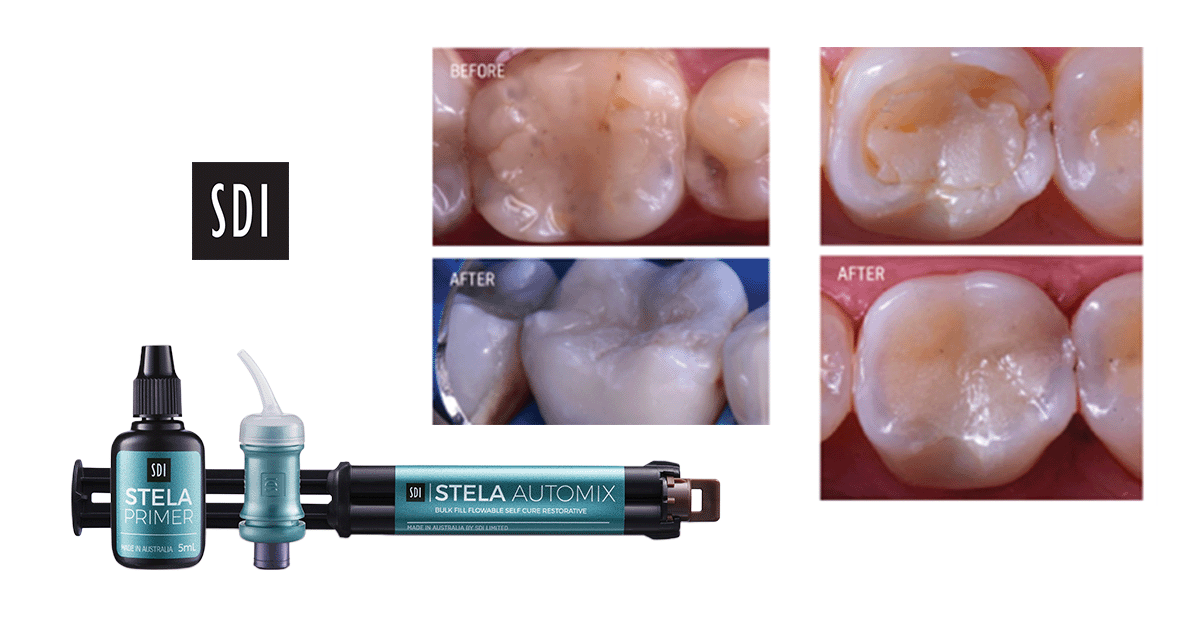
A streamlined restorative workflow is appealing, but how does it stack up clinically? Here is what dental professionals should know about SDI Stela, from its chemistry to published research and two posterior case studies.
Why consider a self-curing dental composite?
Light-cured composite resin is central to restorative dentistry, yet deep preparations and difficult-to-access margins can complicate light delivery. Incremental placement also adds procedural steps. Polymerisation shrinkage and the quality of the adhesive interface remain important considerations for marginal integrity and restoration longevity.
SDI Stela is a self-curing bulk-fill composite designed for single-increment placement without a curing light. Its two-step system pairs Stela Primer with either Stela Automix or Stela Capsule. Because polymerisation is chemically initiated, the material does not depend on light penetration to set at depth. [1]
What makes Stela different?
Stela Primer contains a catalyst that accelerates polymerisation at the tooth-restoration interface. SDI describes this as a low-stress curing approach intended to support marginal adaptation. The material also incorporates BPA-free resin monomers and ionglass™ fillers. Its universal shade is designed to blend with adjacent tooth structure. [1]
For everyday workflow, the attraction is practical: apply the dedicated primer, air-dry as directed, then place the composite in one increment. SDI reports compressive strength of 331 MPa and flexural strength of 143 MPa for Stela Automix. These are laboratory measurements, not guarantees of clinical longevity. [1]
What does the clinical evidence show?
A 2024 in vitro study by Pires and colleagues compared Stela with a light-cured bulk-fill composite and a conventional layered composite. Stela showed the highest bonding performance in the tested conditions and interfaces with few gaps. However, bond strength decreased after 12 months of artificial-saliva storage across all materials. Laboratory findings are encouraging, but cannot establish long-term clinical success on their own. [2]
More directly relevant to practice, a 2025 multicentre, double-blind randomised clinical trial evaluated 165 Class I and II posterior restorations in 55 participants. At 18 months, Stela Automix and Stela Capsule showed functional and biological performance comparable to the light-cured bulk-fill comparator. Some aesthetic measures differed between groups, while overall clinical outcomes and patient satisfaction were unaffected. Longer follow-up is still needed. [3]
Clinical case: Stela Automix in tooth 46
A 33-year-old patient presented with cold sensitivity and food impaction around a defective restoration with secondary caries on tooth 46. After removal of the restoration and affected tissue, the clinical team applied Stela Primer and injected Stela Automix into the preparation. Slow, continuous dispensing from the cavity base was used to limit voids. Following self-curing, the restoration was finished and polished, with satisfactory contour and shade integration reported. [4]
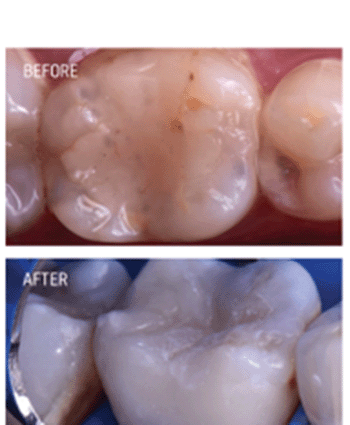
Figure 1. Tooth 46 before (top) and after (bottom) restoration with Stela Automix. Images: SDI clinical case, Federal University of Uberlândia, Brazil.
Clinical case: Stela Capsule in tooth 36
In a second case, a 30-year-old patient had a fractured restoration on tooth 36, with cold sensitivity but no active caries. After preparation and primer application, the team triturated Stela Capsule for 10 seconds and placed the composite in one increment using the Riva Applicator. The restoration was sculpted, set, finished and polished. The patient reported no postoperative sensitivity at the documented assessment. This is an individual case outcome, not a prediction for every patient. [5]
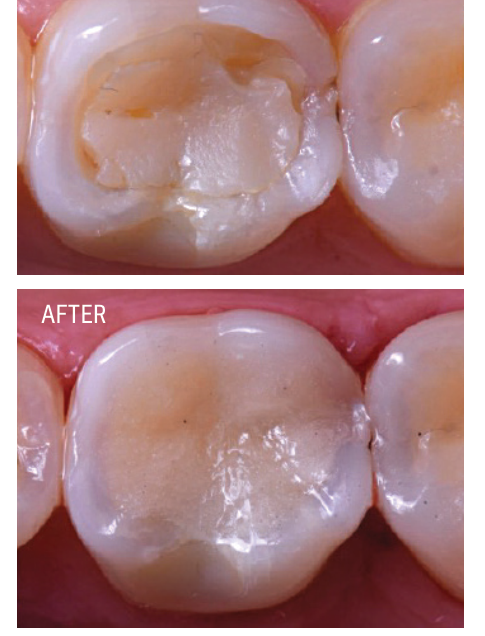
Figure 2. Tooth 36 before (top) and after (bottom) restoration with Stela Capsule. Images: SDI clinical case, Federal University of Uberlândia, Brazil.
Automix or Capsule: which fits your technique?
Stela Automix uses a self-mixing syringe and bendable, rotating metal tip for controlled placement, particularly where access is limited. Stela Capsule is triturated and delivered with an applicator, suiting clinicians who prefer capsule handling and sculpting. Both use the same dedicated Stela Primer and are indicated by SDI for Class I, II, III and V restorations, core build-ups, bases or liners, and sealing endodontic access cavities. [1]
Practical considerations before placement
As with any adhesive restoration, case selection and moisture control remain critical. Assess the remaining tooth structure, functional loading and accessibility of the preparation before choosing a delivery format. Follow SDI’s current instructions for primer application, working and setting times, and finishing. The case reports describe a four-minute self-cure period before finishing procedures, but operators should use the instructions supplied with their specific product. A well-planned matrix and contact-point technique are still important for proximal posterior restorations. Simplifying the curing stage does not replace careful restorative technique or routine review of the restoration over time. [1, 4, 5]
The clinical takeaway
For dental professionals considering alternatives to conventional light-cured composite, Stela offers a distinct self-curing, single-increment approach. Its simplified protocol, published laboratory findings and 18-month clinical data make it worth evaluating for appropriate restorative cases. Material choice should still reflect the preparation, occlusal demands, isolation and the current instructions for use.
Explore SDI Stela Automix and Stela Capsule through Henry Schein New Zealand to see how this self-curing bulk-fill composite could fit your restorative workflow.
References and source notes:
[1] SDI. Stela Self Cure Composite. Australian product brochure. https://www.sdi.com.au/pdfs/brochures/au/stela_sdi_brochures_au.pdf
[2] Pires PM, Neves AA, Lukomska-Szymanska M, et al. Bonding performance and interfacial adaptation of modern bulk-fill restorative composites after aging in artificial saliva: an in vitro study. Clinical Oral Investigations. 2024;28:132. doi:10.1007/s00784-024-05525-5. https://pubmed.ncbi.nlm.nih.gov/38308668/
[3] Loguercio AD, Carpio-Salvatierra B, Ñaupari-Villasante R, et al. Clinical evaluation of a new chemically-cured bulk-fill composite in posterior restorations: 18-Month multicenter double-blind randomized clinical trial. Journal of Dentistry. 2025;162:106031. doi:10.1016/j.jdent.2025.106031. https://pubmed.ncbi.nlm.nih.gov/40818514/
[4] Terán Lozada MI, Avendaño Rondón AK, Soares CJ. Direct restoration with Stela composite. SDI clinical case study, Federal University of Uberlândia, Brazil. Supplied case study: Stela Automix.
[5] Terán Lozada MI, Avendaño Rondón AK, Macias Bautista MDC, Soares CJ. Direct Posterior Restoration with Stela Self Curing Bulk-Fill Composite. SDI clinical case study, Federal University of Uberlândia, Brazil. Supplied case study: Stela Capsule.