Martina Rosenbusch, Dental Technician and Andreas Buchheimer, Dental Technician, Bad Sackingen, Germany
Initial situation vs. final result
Gingival morphology
Thanks to new technological milestones, digital dentures are becoming increasingly common in laboratories. The benefits of digital dentures include efficient fabrication, a good fit without delays, and in the case of loss or damage, reproduction at the touch of a button. Providing the denture base with anatomical morphology is possible in the design software in exactly the same way as using a wax knife and modelling instruments. In addition, as a single-tooth, non-block solution, VITA VIONIC® VIGO already provides the necessary leeway for gingiva during virtual designing of the denture bases. However, until now, the characteristic shade effect of the labial frenulum, blood vessels, alveolar ridges and unattached and attached gingiva, could only be reproduced with analogue craftsmanship and a brush. This is where the VITA AKZENT® LC light-curing composite stains with their multifaceted effects come into play, turning the labial shield into a canvas of creativity.
The labial shield as a canvas of creativity
For micro-retentive adhesion, the labial shield was recontoured using an acrylic bur and the corresponding area sandblasted with aluminium oxide. Finally, a brush was used to bring the monochromatic base to life in the aesthetic zone. For this purpose, VITA AKZENT® LC EFFECT STAINS were used in the blue, pink, white and dark-red shade effects. To characterise the attached gingiva and the labial frenulum, a 1:1 mixture of white and dark red was prepared on the mixing palette. This was used to gently redraw the labial frenulum, and to recontour the shape and shade of the alveolar ridges in the area of the attached gingiva from 13 to 23. In doing so, the unattached marginal gingiva directly surrounding the cervical areas was left out to create a reddish appearance in the alveolar arches. Under the tapered alveolar process and in particular in the concave areas of the labial shield, the mucosa was reproduced using a 1:1 mixture of dark-red and pink. Finally, veins and arteries in the oral mucosa were simulated using blue and dark red. Intermediate curing was performed for each step using the dental curing light to ensure that the stains were fixed before applying the next substance. After the entire customised area was levelled using VITA AKZENT® LC GLAZE, the denture was placed in the light-curing device for final curing.
|
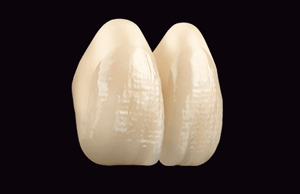
The VITA VIONIC VIGO denture tooth was designed especially for the digital workflow.
|
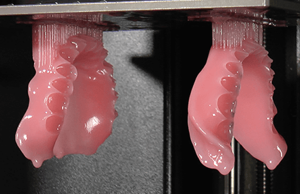
In this case, both denture bases were fabricated additively as part of the digital workflow.
|
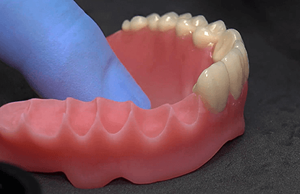
The precise and simple bonding of denture tooth 21 in the alveolus of the denture base.
|
|
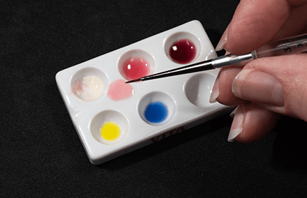
A mixture of VITA AKZENT® LC white and dark-red was prepared on the mixing palette.
|
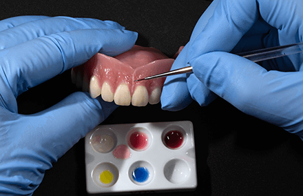
The characterisation of the labial frenulum using the mixture of the VITA AKZENT® LC EFFECT STAINS white and dark-red.
|
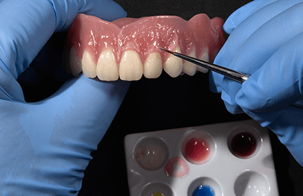
In the area of the attached gingiva, the alveolar process was characterised and recontoured at the same time.
|
|
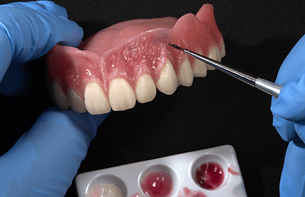
Small veins were simulated in precise detail using VITA AKZENT® LC blue.
|
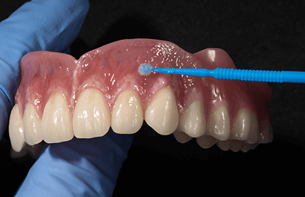
The complete labial shield was sealed using VITA AKZENT® LC GLAZE.
|
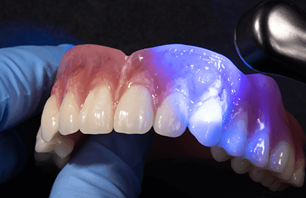
For each intermediate step during characterisation, the dental curing light was used for curing.
|
|
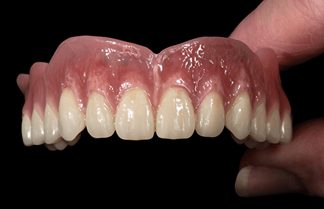
The result after final curing of the complete characterisation in the polymerisation device.
|
|
|
Natural gingival aesthetics
For individualising dental materials that contain polyacrylics. Particularly suitable for denture bases, printed bases made of 3D printing materials and milled bases.